Cornell University

Cornell has a long tradition of leadership in innovative and impactful efforts to advance the science and technology of semiconductors and materials, partnering with industry and the wider research community. Passage of the CHIPS and Science act is leading to even more vigorous engagement and new opportunities to collaborate, advance research and development, and train the next generation of scientists and semiconductor workforce. 

This site serves as a reference point for the research community and a source of information about opportunities and connections across Cornell and beyond.

Opportunities

SponsorTitleLinksDates
National Science Foundation (NSF)CHIPS-Related Funding Opportunitieshttps://new.nsf.gov/chips#funding 
National Institute of Standards and Technology (NIST) https://www.nist.gov/chips 

Awards and Impact

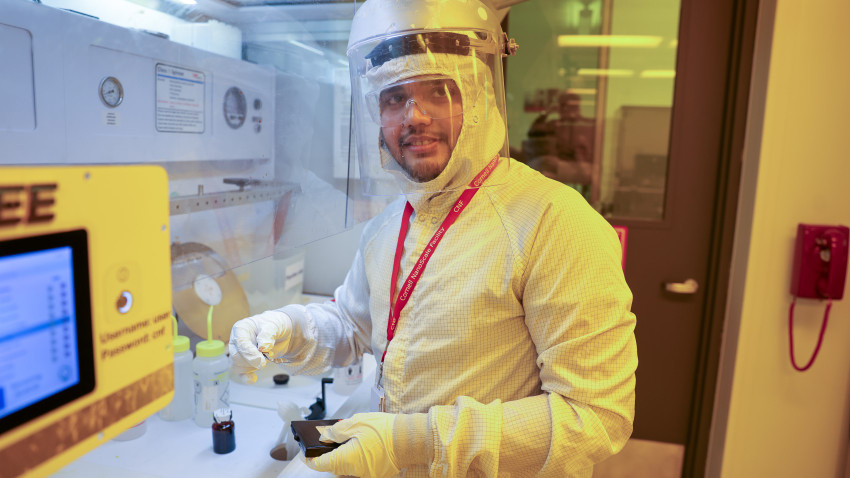
High school seniors from Tompkins-Seneca-Tioga BOCES stepped into the cleanroom at Cornell’s Cornell NanoScale Science and Technology Facility this January, trading classroom labs for hands-on experience in one of the nation’s most advanced university nanofabrication facilities.

February 11, 2026

Cornell researchers have developed a new transistor architecture that could reshape how high-power wireless electronics are engineered, while also addressing supply chain vulnerabilities for a critical semiconductor material.

December 4, 2025

A custom-built, metal-organic chemical vapor deposition system in Duffield Hall will help forge new directions for nitride semiconductors, materials best known for enabling LEDs and 5G communications.

November 12, 2025

Cornell researchers have built a programmable optical chip that can change the color of light by merging photons, without requiring a new chip for new colors – technology that could potentially be used for classical and quantum communications networks.

October 8, 2025

Cornell researchers have demonstrated that, by zapping a thin film with ultrafast pulses of low-frequency infrared light, they can cause its lattice to atomically expand and contract billions of times per second, potentially switching its electronic, magnetic or optical properties on and off.

September 15, 2025

A new innovation from Cornell researchers lowers the energy use needed to power artificial intelligence – a step toward shrinking the carbon footprints of data centers and AI infrastructure.

September 12, 2025